
How Corporate Partnerships Help Nonprofits Reduce Their Dependence on Grants
Build Long-Term Financial Stability Through Diversified Funding

For many nonprofits, grant funding is the ultimate goal. A large grant can launch a new program, expand services, or help your organization reach more people. Because of that, many nonprofits invest countless hours researching opportunities, writing applications, and waiting for funding decisions.
But what happens when a grant isn’t awarded? What if funding priorities change? What if the grant only covers one specific program and can’t be used where your organization needs it most?
These are challenges Kirt Manecke, a nonprofit funding expert who specializes in helping organizations build strong, reliable revenue streams, has helped solve throughout his career.
During a Murad Auctions’ Ask the Experts interview, Kirt shared why he believes many nonprofits unintentionally rely too heavily on grants while overlooking funding sources that can provide greater stability year after year.
His advice isn’t to stop pursuing grants. It’s to build a healthier, more balanced fundraising strategy.
He says two of the most valuable and often overlooked sources of funding are:
- Corporate partnerships
- Individual donors
Together, they can create stronger relationships, diversify revenue, and reduce the uncertainty that comes from depending primarily on grants.
Why Diversifying Your Funding Matters

Every nonprofit wants predictable funding. The more diversified your revenue becomes, the less vulnerable your organization is when one funding source slows down or disappears.
Kirt believes many nonprofits unintentionally put too much emphasis on grants instead of building multiple streams of income that can grow over time. As he explains:
“Grants should be considered icing on the cake, not your main source of funding. Corporate partners provide income for the gap you may be missing with grants. Corporate partners diversify your income.”
Corporate partnerships and individual donors don’t simply provide funding. They create ongoing relationships that can grow for years when nurtured well.
Are Grants Still Worth Pursuing?

Grants can be beneficial, but be strategic about where you invest your time
He explains:
“If you have a big enough staff, then sure, go after grants, especially the ones that you think you have a good feeling that you’re going to get, but they’re very competitive.”
Rather than applying for every available opportunity, focus on grants that closely align with your mission and where your organization has a realistic chance of success. Also, look closer to home before chasing larger national grants.
Kirt also recommends looking closer to home before chasing larger national grants.
“If you want to pursue grants, focus on local family foundations. Look at the guidelines to find out if they fund your nonprofit’s mission. Also look at local community foundations. They usually have grants for local nonprofits who are involved in their specific community.“
These organizations often understand the needs of their local communities and may offer funding opportunities that receive less competition than national grants.
Service clubs are an underutilized way to get easy grant funding, especially if your nonprofit serves the environment or youth in the local community.
The Benefits and Limitations of Grant Funding
Grants remain an important fundraising tool. The right grant can help a nonprofit:
- Launch new programs
- Expand services
- Fund special initiatives
- Increase community impact
However, Kirt reminds nonprofit leaders that grants also come with significant responsibilities.
“They come with a lot of ties to them. It’s usually not unrestricted funding, meaning you can’t use it for whatever program you want, and it’s very time-consuming to complete the necessary annual reporting that is required.“
Those reporting requirements often consume valuable staff time that could otherwise be invested in strengthening donor relationships or building long-term corporate partnerships.
Don’t Overlook Local Service Organizations

One of Kirt’s most practical fundraising recommendations is one many nonprofits rarely consider. He suggests building relationships with organizations like:
- Rotary Clubs
- Lions Clubs
- Kiwanis Clubs
These organizations already exist to strengthen their communities and support charitable causes.
Service clubs are an underutilized way to get easy grant funding, especially if your nonprofit serves the environment or youth in the local community.
As Kirt explains:
“That’s a very underutilized way to get really easy grant funding, especially if you’re into the environment or you help youth, or you’re in the local community.”
But the opportunity doesn’t stop with small grants.
Service Organizations Can Open Many More Doors
Kirt says these organizations offer something even more valuable than funding. They’re filled with people who already care about giving back.
Kirt points out, “These members are already giving. They’re used to giving. They’re used to volunteering. So that’s your perfect target audience.“
Members often become much more than grant providers. As Kirt explains:
“Some of the individual members of Rotary or Kiwanis or Lions clubs might become individual members or major donors of your organization. Those same relationships can also introduce nonprofits to business owners, corporate decision-makers, volunteers, and future fundraising champions. Sometimes one conversation leads to many more.“
Those same relationships can also introduce nonprofits to business owners, corporate decision-makers, volunteers, and future fundraising champions. Sometimes one conversation leads to many more.
Chamber of Commerce Networking Can Lead to Corporate Partnerships
Kirt shared a simple story that demonstrates how opportunities often begin long before a fundraising ask.
While attending Chamber of Commerce meetings on behalf of an autism nonprofit, he introduced himself by saying:
“I’m from the nonprofit XYZ. We’re looking for corporate sponsors to help young adults transition into the workplace.“
The result was surprising. After the meeting, a gentleman came up from a large corporation and said he would be interested in becoming a corporate sponsor. That opportunity didn’t begin with a formal proposal. It began with a conversation. Networking events, local business organizations, and community relationships can be among the most valuable places to identify future corporate partners.
That opportunity didn’t begin with a formal proposal. It began with a conversation. Networking events, local business organizations, and community relationships can be among the most valuable places to identify future corporate partners.
Build Stability Instead of Uncertainty
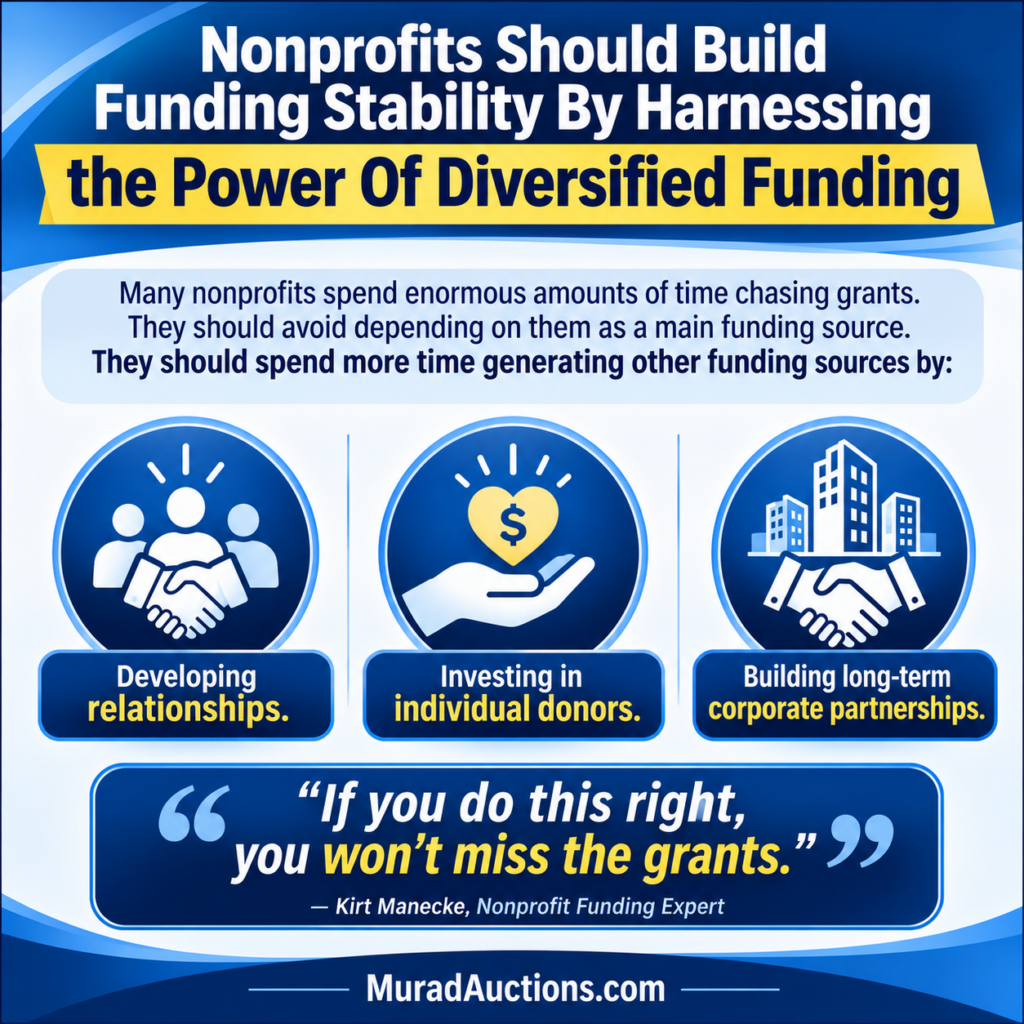
Many nonprofits spend enormous amounts of time chasing the next grant. Kirt encourages organizations to think differently and:
- Develop relationships with local community organizations.
- Invest in individual donors.
- Build long-term corporate partnerships.
- Continue pursuing grants, but don’t depend on them to carry your organization.
Kirt says:
“If you do this right, you won’t miss the grants.”
That’s the power of diversified fundraising.
Action Steps
Take time to evaluate your overall fundraising strategy by taking the following steps:
✔ Reviewing how much of your annual funding currently comes from grants.
✔ Researching local family foundations that align with your mission.
✔ Connecting with your community foundation to learn about funding opportunities.
✔ Visiting a Rotary, Lions, or Kiwanis Club meeting in your area.
✔ Attending Chamber of Commerce networking events and begin building relationships with local business leaders.
✔ Developing a plan to strengthen your individual donor program along with your grant strategy.
The stronger and more diverse your funding sources become, the more financially stable your nonprofit will be, regardless of changes in grant funding.
Continue Learning from the Ask the Experts Fundraising Series
Throughout this Ask the Experts series, Kirt shares practical strategies drawn from decades of fundraising experience to help nonprofits build stronger, more sustainable funding programs. You’ll discover how to develop meaningful corporate partnerships, strengthen donor relationships, improve fundraising communications, and uncover overlooked opportunities that can increase revenue while reducing dependence on grants.
Watch the full video here to learn about these topics.
Whether your organization is just getting started or looking to grow its fundraising efforts, each article is filled with actionable ideas you can begin implementing right away.
Watch for the remaining blogs in this series:
- Part 2: Why Corporate Partnerships Outperform One-Time Sponsorships
- Part 3: How to Approach Businesses Without Feeling Like You’re Asking for Money
- Part 4: Building Long-Term Corporate Relationships That Grow Every Year
- Part 5: Simple Relationship-Building Habits That Lead to More Donations and Corporate Support
Together, these five blogs provide a practical roadmap for building a more diversified, stable, and sustainable fundraising program.
Ready to Strengthen Your Nonprofit’s Fundraising?
If your nonprofit wants to build stronger corporate partnerships, attract more individual donors, and create a more predictable fundraising strategy, Kirt Manecke can help.
Whether you need help creating a corporate partnership strategy, strengthening donor relationships, or developing a long-term fundraising plan, Kirt offers practical, real-world solutions based on years of experience.
Learn more or connect with Kirt at:
kirtmanecke.com
kirtm@comcast.net
248-880-5361
Don’t Miss Future Fundraising Tips
Murad Auctions’ Ask the Experts series brings together experienced fundraising professionals to share proven strategies, practical ideas, and real-world advice to help nonprofits raise more money and further their mission.
Subscribe to our YouTube channel, follow our blog, and watch for the next article in this 5-part series to continue learning new ways to grow your nonprofit’s impact.